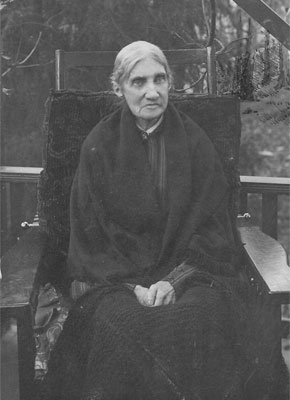
Eliza Jane Brown was born on October 20, 1816, as the fourth child and first daughter to Henry Brown, one of Dayton's first merchants and settlers, and Catherine "Kitty" Patterson Brown, daughter of Colonel Robert Patterson, a famous Revolutionary War soldier and Native-American fighter, who settled in Dayton in 1804. Eliza was born and raised in Dayton, Ohio, in the original 1808 brick home that her father built on Main Street.
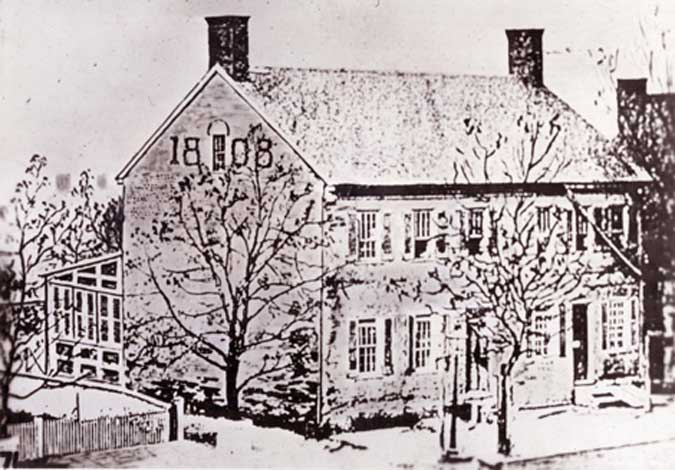
Eliza likely worked and played with her siblings in the "in-lot" on the south side of the brick house where their father kept livestock, an outhouse, a well, and a kitchen garden.
LINK TO ENDNOTE: What are "in-lots" and "out-lots?"
As education was important to her mother, Kitty would have sent Eliza to attend the Dayton Academy for her primary education. However, until 1840, enrollment was limited to boys.
Kitty was close to the Galloway family of neighboring Greene County. Like the Pattersons, the Galloways had migrated from Kentucky. Because the families knew one another, Kitty arranged for Eliza to live with the Galloways and attend school in Xenia, which was in Greene County.
Eliza studied in a one-room schoolhouse that served both boys and girls. The arrangement resembled Kitty's own early schooling in Dayton at Newcom's Tavern with her Patterson siblings and other local children. In Xenia, Eliza likely learned the basics of reading, writing, and arithmetic.
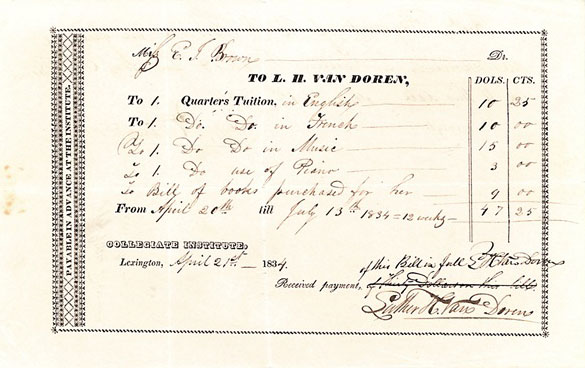
After her elementary education, Kitty sent Eliza to live with her aunt, Mrs. John (Jane) Steele (Kitty's sister) in Lexington, Kentucky. There, Eliza enrolled in the Collegiate Institute of Lexington, a secondary school, where she studied the "feminine" subjects of the time: music, piano, English, French, and drawing.
However, Eliza's education was more advanced as it included botany and chemistry, subjects typically taught to boys. Receipts for Eliza from the Collegiate Institute can be found in the Brown-Patterson Papers at the Dayton Metro Library.
On September 16, 1835, Eliza married Charles Anderson of Louisville, Kentucky. They had six children, but only three lived to adulthood. Eliza's older brother, Robert P. Brown, and his wife, Sarah, also had only three out of six children live to adulthood.
LINK TO ENDNOTE: Who were Charles and Eliza Anderson's children?
LINK TO ENDNOTE: Why did half of Charles and Eliza Anderson's children die so young?
LINK TO ENDNOTE: Read about the marriages of Charles and Eliza Anderson's children!
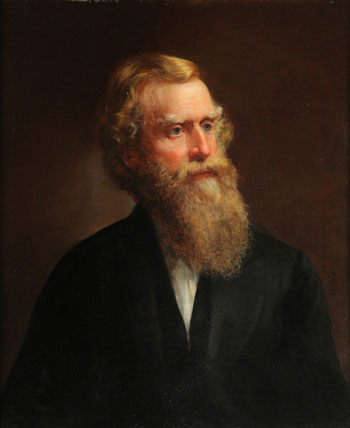
Originally from Louisville, Kentucky, Charles was well-educated, graduating from Miami University, Oxford, Ohio, in 1833. He then returned to Louisville to study law. In 1835, Charles moved to Dayton to practice law. He likely met Eliza following his move to Dayton.
After their wedding, Charles and Eliza built a mansion on land she inherited from her grandfather, Col. Robert Patterson, on his death in 1827. The land was formerly part of Col. Robert's Rubicon Farm. The mansion and surrounding land were referred to as "Dewberry Farm."
Charles was admitted to the bar in 1835 and eventually became the Prosecuting Attorney for Montgomery County. He was elected to the Ohio State Senate in 1844 as a member of the Whig Party. Charles supported African-American civil rights.
LINK TO ENDNOTE: What was the Whig Party?
In 1846, after one term (2 years) in the Ohio Senate, Charles and Eliza decided to move their family to San Antonio, Texas, for his health.
They sold Dewberry Farm to the Stuart family, who eventually sold it to the priests and brothers of the Society of Mary (Marianists), a Catholic teaching order, in 1850. Dewberry Farm was renamed "Nazareth" and eventually became the University of Dayton.
In San Antonio, the Andersons purchased a ranch and bred horses intended for the U.S. Calvary. While there, they became acquainted with then-Colonel Robert E. Lee and spent much of their social life at the U.S. Army Post.
Texas seceded from the Union on March 2, 1861. And the Civil War started on April 12, 1861. Charles was vocal about his opposition to succession. Because of his Union sympathies, the Confederates arrested Charles for treason in September 1861.
Meanwhile, Eliza and her children were deported to Vera Cruz, Mexico. Charles was able to escape and joined Eliza in Vera Cruz. From there, they sailed to New York and returned to Dayton.
On August 9, 1862, following a pro-Union lecture tour, Charles joined the 93rd Ohio Volunteer Infantry (OVI) and became its commanding colonel. He was wounded at the Battle of Stones River, Tennessee (December 31, 1862 — January 2, 1863). His injuries prevented further combat service.
In 1864, Charles was elected as Lieutenant Governor for Ohio, serving under Governor John Brough. When Governor Brough died on August 29, 1865, Charles briefly served as the 27th Governor of Ohio. Eliza served as First Lady of Ohio during those months.

Charles decided not to seek election as governor and returned with Eliza to Dayton. There, he resumed his law practice.
By 1870, Charles and Eliza, and their children moved to Kuttawa, Kentucky. Litte information is currently available about their life in Kentucky. Charles Anderson died on September 2, 1895, and Eliza J. Brown Anderson died on November 19, 1901. Both are buried in Kuttawa Cemetery, Kentucky.
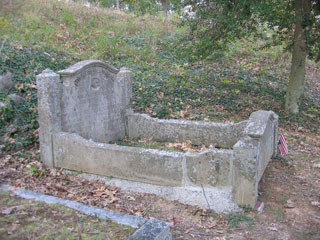
ENDNOTE - What are "in-lots" and "out-lots?"
In early settlements, where Native Americans posed danger, most settlers had "in-lots" within the town limits. These were typically adjacent to settlers' homes where they could keep a horse for transportation, a cow for milk, a few chickens for meat and eggs, and a few pigs for meat. The in-lots were usually no more than 1/4 acre and not intended for regular farming.
The in-lot might have a small barn and chicken coop, and a kitchen/medicinal garden. It would also contain a well for water and the family outhouse. Because the in-lots were small and held animals, it often resulted in unpleasant smells, disease, and sanitation issues. However, they offered protection for precious food sources.
These settlers typically had “out-lots” for growing crops outside of the town limits. Most of the work of growing crops was done during the daylight hours when threats from Native Americans could be seen.
Out-lots also gave settlers a measure of self-sufficiency. They could grow crops for their own use and often transport surplus harvests to markets such as Cincinnati or farther south to New Orleans, where the sales provided additional income.
ENDNOTE - Who were Charles and Eliza Anderson's children?
Charles and Eliza Anderson had six children; three lived to adulthood. They were:
ENDNOTE - Why did half of Charles and Eliza Anderson's children die so young?
The exact cause of death for Charles and Eliza Anderson's children cannot be stated with any certainty. And Ohio did not require death certificates until January 1866. However, Greene County, Ohio, adjacent to Montgomery County, kept excellent records on infant mortality in the early 19th century. Looking at its records is helpful. They show that infant mortality was exceptionally high, with up to 30% of children dying before their first birthday and over 40% not surviving past age five. The common causes included diarrhea, dysentery, prematurity, and infections, often driven by poor sanitation. (https://www.greenecountyohio.gov/Blog.aspx?IID=180)
An earlier endnote referred to the use of in-lots adjacent to city homes where livestock (chickens, pigs, a cow, and a horse) would be kept handy. These animals typically shared a small amount of space with the family outhouse and well. The possibility of contamination was high.
ENDNOTE - Read about the marriages of Charles and Eliza Anderson's children!
Two of Charles and Eliza Anderson's three surviving children married:
ENDNOTE - What was the Whig Party?
The Whig Party, active from 1834 to 1854, formed in opposition to President Andrew Jackson's expansion of executive power. Led by prominent figures such as Henry Clay and Daniel Webster, the party emphasized the authority of Congress. Internal divisions over slavery, along with the deaths of Clay and Webster, contributed to its decline.
Conover, C. R. (1902). Concerning the Forefathers: Being a Memoir, with Personal Narrative and Letters of Two Pioneers, Col Robert Patterson and Col John Johnston. New York: Winthrop Press.
Conover, C. R. (Ed). (1914). A Memoir: With Letters, of Mrs. Horatio G. Phillips, "Kitty" Patterson, A Pioneer Woman. Dayton, OH: N.C.R. Co.
Conover, C. R. (1917). The Story of Dayton. Dayton, OH: The Greater Dayton Association/The Otterbein Press.
Dalton, M. (2018, September 21). Diseases and Child Mortality in Early America. Greene County Archives. https://www.greenecountyohio.gov/Blog.aspx?IID=180
Drury, A. W. (1909). History of the City of Dayton and Montgomery County, Ohio, Vol. I. Chicago: S. J. Clarke.
Edgar, J. F. (1896/2008). Pioneer Life in Dayton [Ohio] & Vicinity, 1796-1840. Westminster, MD: Heritage Books.
Knepper, G. W. (1989). Ohio and its People. Kent, OH: The Kent State University Press.
Papers of the Brown & Patterson Families. (1797-1902). [Manuscript collection]. Brown-Patterson Papers Collection (MS-015, Series III, Box 1, File 15). Dayton Metro Library, Dayton, OH.