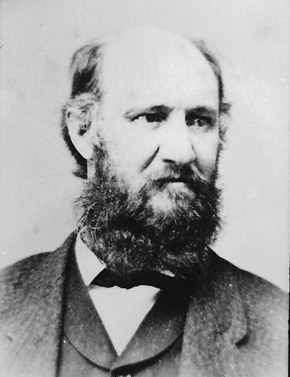
Following the death of her husband, Henry Brown, in 1823, Catherine "Kitty" Patterson Brown, married Andrew Irwin, a dry-goods merchant in Dayton, on January 27, 1825. Andrew Barr Irwin, Kitty and Andrew's only child, was born March 23, 1827, in Dayton. Kitty's second husband, Andrew, died September 11, 1827, of an unknown fever.
Andrew Barr Irwin, commonly known as "Barr," was born and raised in the original 1808 brick home that Kitty's first husband, Henry Brown, built on Main Street.
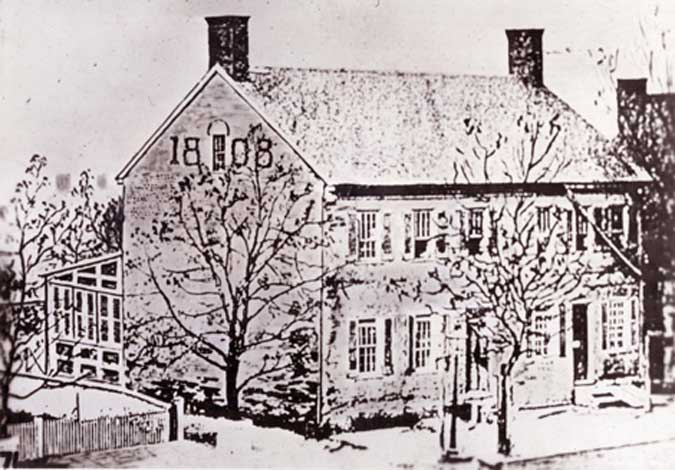
Barr likely worked and played in the "in-lot" on the south side of the brick house where his family kept livestock, an outhouse, a well, and a kitchen garden.
LINK TO ENDNOTE: What are "in-lots" and "out-lots?"
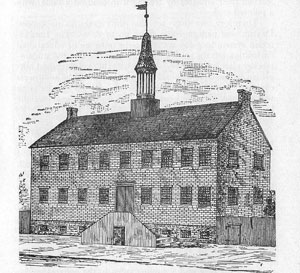
As education was important to his mother, Kitty, Barr likely received his primary education at the Dayton Academy, where he would have studied reading, writing, and arithmetic. The new academy at the southwest corner of Fourth and Wilkinson Streets was built after the original academy became too small for the increasing enrollment. Built in 1833, the new academy was still limited to boys and required tuition. However, by 1840, the school admitted both boys and girls, and it was tuition-free. This followed Ohio reforms in state-wide education during the 1830s.
No information is available concerning Barr receiving a secondary education. However, as he eventually became an attorney, he likely received further education.
In the 1850 federal census, Barr's occupation is simply listed as "clerk" without any other information. However, the 1856 Williams's Dayton Directory identifies him as a bookkeeper at the Cooper Cotton Factory.
By early 1859, Barr and his older, half-brother, Henry L. Brown, took ownership of an iron foundry. It was located at the south end of Ludlow Street where it terminated at the Miami Canal. The foundry produced cast-iron stoves and other hardware. Many of its products, such as cast-iron fences and gates, are still in use in the Dayton area, as well as kettles, skillets, and "frog" doorstops.
The half-brothers initially sold their iron products from a stand at the corner of East First and Mill Streets (now Patterson Boulevard). Later, they opened the Brown & Irwin Stove and Hollow-Ware Store at 89 Main Street in downtown Dayton.
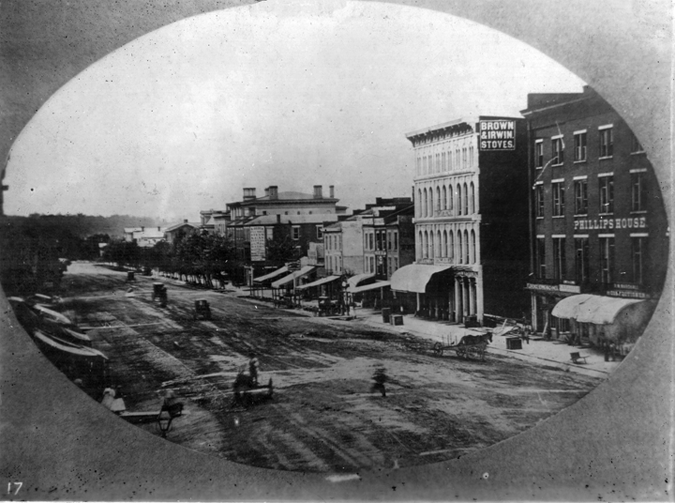
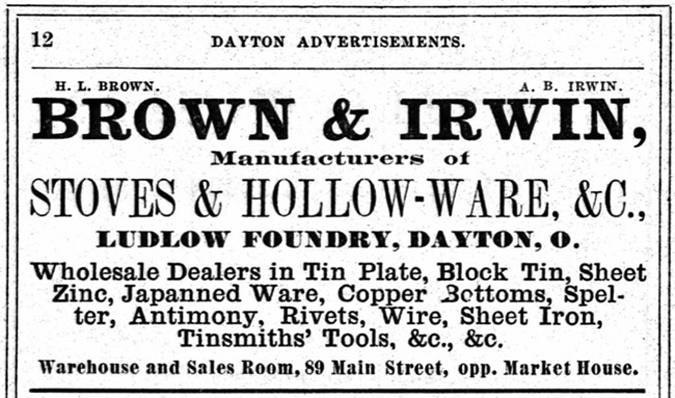
The Brown & Irwin Stove and Hollow-Ware Store remained in business for nearly 20 years.
On April 23, 1863, Barr married Jane Findlay Schenck of Long Island, New York, in Dayton. She was the daughter of Rear Admiral James Findlay Schenck, originally from Franklin, Ohio, and Doretha Ann Smith Schenk, originally from Smithtown, New York.
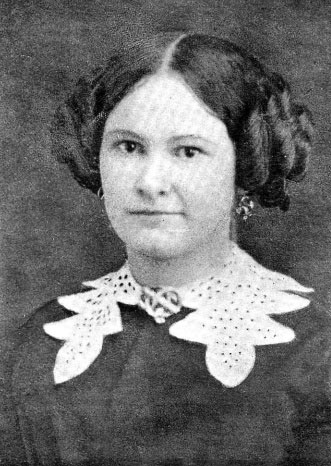
Barr and Jane had four children, all of whom lived to adulthood.
LINK TO ENDNOTE: Who were Barr and Sarah Irwin's children?
LINK TO ENDNOTE: Read about the marriages of Barr and Sarah Irwin's children!
In 1877, Barr moved his family to Kuttawa, Kentucky. He wanted to be close to his elder half-sister, Eliza Jane Brown Anderson. There, he became a partner in the law firm of Irwin and Skinner, eventually becoming a judge. He also operated a dry-goods store.
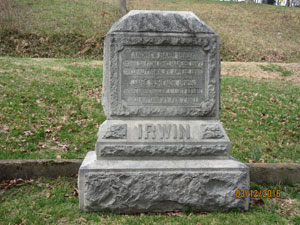
""Jane Irwin, died on February 7, 1897, and Andrew “Barr" Irwin died on April 19, 1898. Both are buried in Kuttawa, Kentucky.
ENDNOTE - What are "in-lots" and "out-lots?"
In early settlements, where Native Americans posed danger, most settlers had "in-lots" within the town limits. These were typically adjacent to settlers' homes where they could keep a horse for transportation, a cow for milk, a few chickens for meat and eggs, and a few pigs for meat. The in-lots were usually no more than 1/4 acre and not intended for regular farming.
The in-lot might have a small barn and chicken coop, and a kitchen/medicinal garden. It would also contain a well for water and the family outhouse. Because the in-lots were small and held animals, it often resulted in unpleasant smells, disease, and sanitation issues. However, they offered protection for precious food sources.
These settlers typically had “out-lots” for growing crops outside of the town limits. Most of the work of growing crops was done during the daylight hours when threats from Native Americans could be seen.
Out-lots also gave settlers a measure of self-sufficiency. They could grow crops for their own use and often transport surplus harvests to markets such as Cincinnati or farther south to New Orleans, where the sales provided additional income.
ENDNOTE - Who were Barr and Sarah Irwin's children?
Barr and Jane Irwin would have four children, all living to adulthood. They were:
ENDNOTE - Read about the marriages of Barr and Sarah Irwin's children!
Only one child of Barr and Sarah Brown would marry:
Brown. H. L., & Irwin, A. B. (1859, April 5). Dealers in Juniatta Iron Nails [Advertisement]. Dayton Daily Empire, 4, newspapers.com
Conover, C. R. (1902). Concerning the Forefathers: Being a Memoir, with Personal Narrative and Letters of Two Pioneers, Col Robert Patterson and Col John Johnston. New York: Winthrop Press.
Conover, C. R. (Ed). (1914). A Memoir: With Letters, of Mrs. Horatio G. Phillips, "Kitty" Patterson, A Pioneer Woman. Dayton, OH: N.C.R. Co.
Conover, C. R. (1917). The Story of Dayton. Dayton, OH: The Greater Dayton Association/The Otterbein Press.
Drury, A. W. (1909). History of the City of Dayton and Montgomery County, Ohio, Vol. I. Chicago: S. J. Clarke.
Edgar, J. F. (1896/2008). Pioneer Life in Dayton [Ohio] & Vicinity, 1796-1840. Westminster, MD: Heritage Books.
Knepper, G. W. (1989). Ohio and its People. Kent, OH: The Kent State University Press.
U.S. Census Bureau. (1850). 1850 United States Federal Census [Database]. FamilySearch.org. Retrieved from familysearch.org
Williams' Dayton Directory, City Guide, and Business Mirror, Vol. 1. (1856-57). Dayton, OH: Ells, Marquis & Co.
Williams' Dayton Directory, City Guide, and Business Mirror, Vol. 8. (1860-61). Dayton, OH: James Rickey.